International Kung Fu Association
Hung Ga Kung Fu in the Shaolin Temple
1500 years in the making
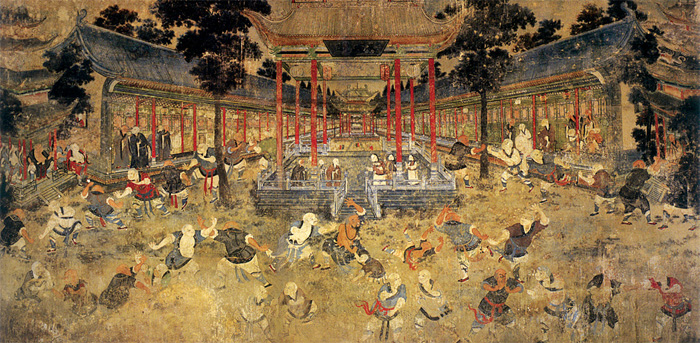
A Brief History of Shaolin Kung Fu
Dat Mo came to Guangzhou from India by sea. Over a period of three years, he headed North through Nan Jing, and crossed the Yangtze river to reach the Shaolin temple. Once there, he introduced the temple monks to Buddhism, which later became the Chinese Chan religion. After six generations, the temple split into two lineages, the Southern one descending from Wai Lang (慧能) and the Northern from Sun Sao (神秀). It is widely believed that Dat Mo brought Martial Arts knowledge to China, but in actual fact he only brought Buddhist teachings.
There is very little documented information, but research points towards people already having Martial Arts knowledge, and that they brought this into the temple when they became monks. By incorporating the philosophies of Chan, this pre-existing Kung Fu was improved. The combination of Buddhism and Martial Arts is what became known as the Shaolin lineage. Shaolin Pai (Kung Fu history) begins with Dat Mo and culminates in the Ming Dynasty (1368-1644), when it is said to have become complete. Until this time, their Kung Fu was still very limited, but by combining the internal and external methods, they were able to achieve completion. After the Ming dynasty, many people claimed to be Shaolin to make themselves look better, thus spreading its fame far and wide.
During the Ming Dynasty, Tong Ging Chuen (唐荆川) said that the Shaolin temple pole was very good but their empty-hand methods were mediocre. Ching Zhong Hing (程宗献) in Shaolin Pole Fighting Method said that “If the Shaolin temple pole is so good, why are they practicing with their fists all the time?” Of course, they were practicing their fist methods as they were not as good as their pole, but from this, we can see that their Kung Fu was not yet complete.
Chan Buddhism and Martial Arts did not combine very well. The hand fighting was very hard with few soft techniques, and many internal styles emerged at this time. During Ming Chiu Ga Jing (明朝嘉靖, 1522-1566), the 17th generation Shaolin Abbott Gok Yuin Sheung Yan (觉远上人) worked tirelessly to combine the hard and soft and complete their style.
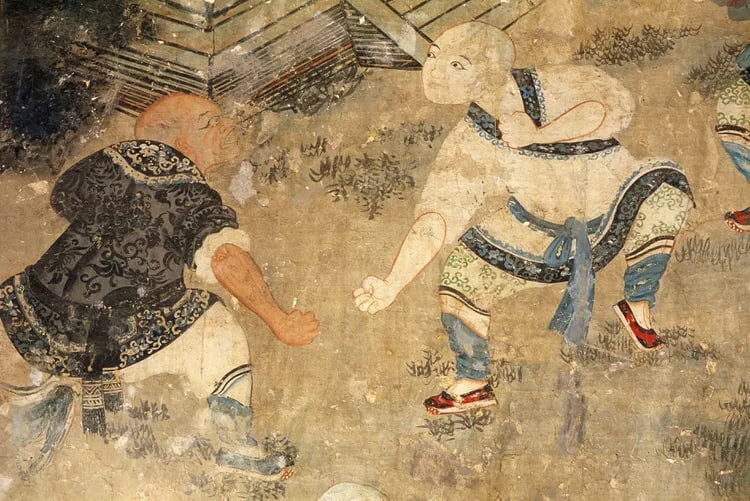
Origins of The Five Animal Form
Legend has it that the five animal form comes from the Gun Dynasty period (Jin Ai Zong (金衰宗), 1224-1234), we have found evidence of the following:
The form first appears from Bak Yook Fung (白玉峰) a martial artist from Taiyuan city, in the Shanxi province of Western China. As we shall see below, Bak Yook Fung was a Shaolin temple monk and therefore learned both Chan and Shaolin Kung Fu. He added to this his own Kung Fu knowledge and founded the Five Animal Fist. He said the human body needs to train five things: the spirit, the strength, the Qi, the bones, and the sinews. These five must be combined to reach the highest level. This is why the Dragon trains the spirit, the Snake trains the Qi, the Tiger strengthens the bones, the Leopard increases the strength, and the Crane strengthens the sinews.
Source:
Zhong Guo Wushu encyclopedia - Zhong Guo Mow Shut Bak For Qin Ji (中国武术百科全书) Beijing: Zhong Guo Encyclopedia Publisher, 1998 (ISBN 7500060874 / 9787500060871).
The Resurgence of the Shaolin Fist
Gok Yuin Sheung Yan (觉远上人) was from Yan Zhou, modern-day Zhejiang province. He was from a rich family but surprisingly became a monk, and he was a very charismatic man. His Martial Arts in general and sabre in particular were known to be very good. In the Shaolin temple, he learned the 18 Lo Han hand techniques and extended them to become 72. Gok Yuin could tell that it wasn't the best, that it wasn't complete, and so he wouldn't teach. Later in his life, he disguised himself in normal clothes and set out to travel in the Northern and Western parts of China to seek out teachers and better Kung Fu.
Finally, one day in Lanzhou city in the province of Gansu, Gok Yuin saw an old man buying soy sauce in the market. The old man wasn't very careful walking back and spilled some on a passer-by. The man was angered and tried to hit him three times, missing every time. The old man tried to bow and scrape but the angry man would not relent and became furious. He then tried to kick the old man in the head, who said loudly “I've apologised, I'm an old man, forgive me or you might kill me”. The angry man carried on trying to kick him and a crowd gathered.
Gok Yuin started to worry that if a blow was landed, the old man could be seriously injured. As he approached to help, the old man was backed into a corner and waited. Suddenly, the angry man ran towards him and attempted a flying kick, which the old man also evaded. The kicks grew stronger and stronger, until sand could be seen coming out of the wall. Finally, the old man moved lightly to the side to escape another kick and used his first two knuckles to strike the angry man's leg. The man immediately fell down and could not move, his face turning white and his lips blue, which is how he stayed until someone carried him away.
The crowd was stupefied, including Gok Yuin. He decided to follow the old man back to his small home away from the market, where he entered and let out a long sigh. Forgetting his manners, Gok Yuin simply walked in without knocking and announced his name. The old man was called Old Man Lee. He was from Zhongzhou, but moved to Lanzhou many years ago, and had a son who was a carpenter. He looked very worried and Gok Yuin asked him how he could be worried with such kung fu skills. The old man shook his head: “This was an unlucky encounter. That man is a gangster and next time he won’t let me go. I’m afraid because I’m not so young anymore, and I am an outsider here.”
Gok Yuin invited Lee to join him in traveling, but Lee was unconvinced. He didn’t want to get Gok Yuin in trouble—and besides, he could never leave his son, and traveling with three was difficult. Gok Yuin then told him the truth: that he was a Shaolin monk looking for accomplished martial artists. Lee denied that his kung fu was that good, but as Gok Yuin had shown respect, he promised to introduce him to his friend Bak Yook Fung (白玉峰) in Taiyuan. “He is a top martial artist,” said Lee. “At the Yangtze River no one can compare with him. Next to him, I’m nothing.” Bak Yook Fung was then teaching in Lok Yuerng city (洛阳), and Gok Yuin thought that if he could learn from Bak Yook Fung, Shaolin kung fu would greatly improve. Gok Yuin insisted that Old Man Lee and his son join him, and Lee eventually agreed.
When they arrived in Lok Yeurng city and saw Bak Yook Fung, Gok Yuin noticed that he was around 50 years old and very short, but his strong spirit showed in his face. Lee introduced them, and they stayed in the Tong Fuk Temple (同福寺) in Lok Yeurng. Lee taught them everything he knew. Gok Yuin kept pressing Lee and Bak Yook Fung to go to the temple and they finally agreed, since they could tell that he was a serious student. Not long later, Bak Yook Fung became a monk. Lee stayed as a layperson but also learned the religion and was given the Buddhist name Qing Wai (澄慧). Bak Yook Fung’s martial art specialized in Qi gong. After he was ordained, he studied Shaolin kung fu and Chan Buddhism diligently. The martial arts in the temple changed greatly. Based on the old 72 techniques, they created 172, the Five Animal Fist: dragon, snake, tiger, leopard, and crane. Now the style was complete, and Shaolin became one of the strongest kung fu lineages. Gok Yuin and Bak Yook Fung both had hugely important roles in this and should never be forgotten.
Source:
Zhong Guo Tradition Wu Shu History (中国传统武术史). Beijing: Beijing Renmin University, 2006 (ISBN 7300070604 / 9787300070605).
History of Hung Ga from The Southern Shaolin Temple
Many people believe that Hung Ga was founded by Hung Hei Guen (洪熙官), but research shows that the root was not from one person alone. It came from associations that sought to restore the Ming dynasty, after it had been overthrown by the unpopular Qing dynasty. The Ming dynasty were Han Chinese, and they lost the country, the Hung character (洪) is the Han character (漢) without the middle land (中土) in the middle. The character was also chosen because the first Ming emperor was called Hungwu (洪武), hence the associations were called Hung Door and later Hung Ga Association.
Legend tells that Gee Shim was the Abbott monk of the Shaolin temple, who taught at the Guang Xiao temple (光孝寺), in Guangdong province. We hear further that Hung Hei Guen was from Hua Xian (花县), also in Guangdong, and that he taught at the Dai Fut temple(大佛寺). As well as these two supposed founders of Hung Ga, we hear of Fung Xi Yu from Gao Yao city, whose mother and father were also very famous. However, none of the available resources indicate that there has ever been a Gee in any of the 70 lineages. Consulting further the Hua Xian history, the Gao Yao city history, and even the Hung Family Lineage book, leads us to conclude that nowhere can these names really be found. It is entirely possible that they have never existed, and that they come from stories such as This is the South and 10,000 Years Young.
There is strong evidence that links Hung Ga Kung Fu to the Shaolin Kung Fu at the time of Gok Yuin and Bak Yook Fung. Hung Toe in the Hao Ching claims that the Five Fists comes from the Yat Yuet (日月), which is the Hung Moon, literally Heaven & Earth Association, i.e. the Hung Ga Kuen. Chan Tit Sung (陈铁生), a famous Cantonese martial artist, wrote a book called Mou Fu (武库), “Martial Art Stories”. In this, he notices that all of the pictures from the Shaolin fighting art closely resemble Hung Ga Kuen, which he calls the “pearl of the Cantonese Kung Fu styles”. Choy Jit Dong (徐哲东), another famous artist, said that his friend Master Low Hip (刘协) from the Hunan province, practiced a Five Animal Form that used the Dragon, Snake, Tiger, Leopard and Crane that was the same as the Guangdong Hung Ga style.
Sources:
Dictionary of Chinese Wushu Martial Arts (中国武术大辞典). Beijing: Renmin Physical Education Publisher, 1990 (ISBN 7500904630 / 9787500904632).
Guang Dong Wushu History (广东武术史) Guangdong: Guangdong Renmin Publisher, 1989 (ISBN 7218004342 / 9787218004341).
Services
Our Style
School Locations
Copyright © 2025 Yee's Hung Ga International Kung Fu Association.
All rights reserved.
USA Headquarters - 68 Union Ave, Clifton, NJ 07011
+1 (973) 772-8988